

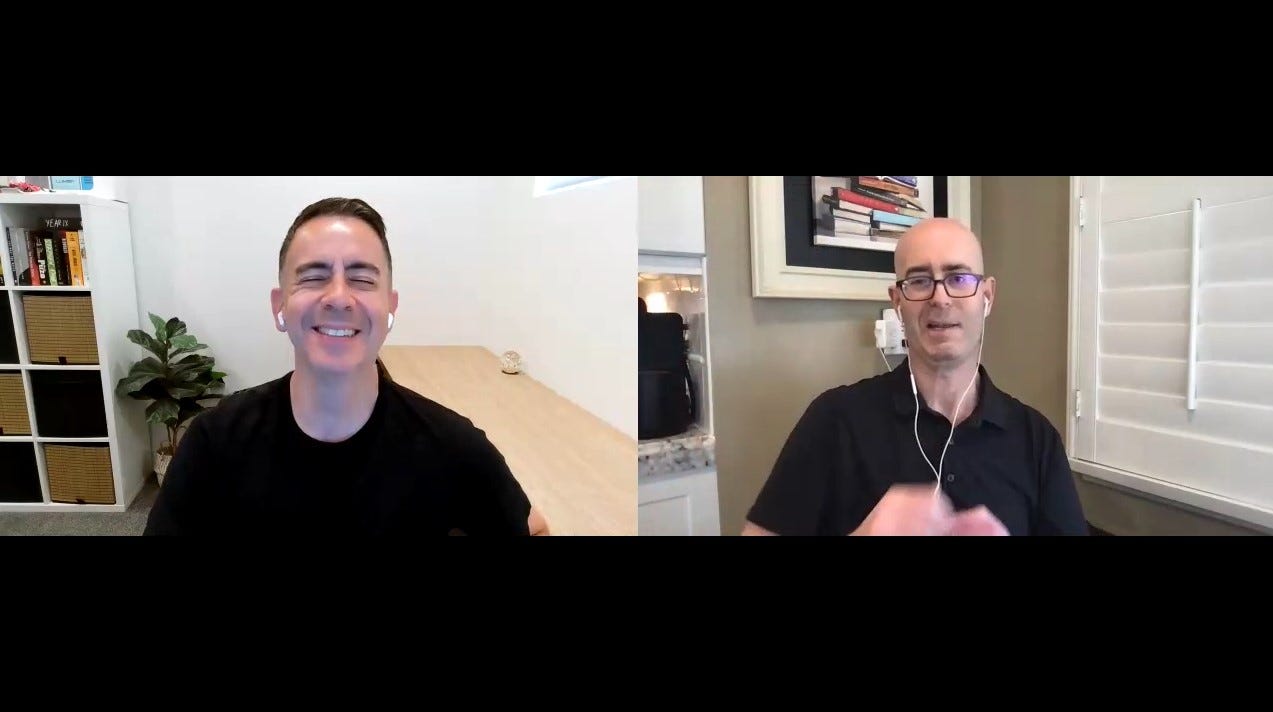
Seventeen years ago, Bryan Bishop was told he had six months to live.
He was 30. Two months away from his wedding. Working his dream job as the affable, razor-sharp sidekick known to millions as “Bald Bryan” on The Adam Carolla Show. And then, suddenly, he was confronting an expiration date. “My first thought,” he tells me, without flinching, “was, holy shit.”
He describes realizing, in real time, what a “cold sweat” actually is. “I started to perspire, but I was freezing, and I’m like, oh, this is a cold sweat. I’ve been told that I’m going to die in 6 months.” There is no melodrama in his voice when he recounts it. Just memory. And then, just as quickly, something else surfaced. “I thought, well, that’s not going to be me.” That belief, naive or not, carried him. “I just never, never really believed that that would be me - that I’d be gone in 6 to 12 months.” He pauses, almost apologetic for not offering something more mystical. “I wish I was a more spiritual person and say that there was some divine intervention, but that’s just how I felt at that moment.”
Seventeen years later, Bishop is fighting on. And he has made a film about it.
A cancer documentary that actually makes you laugh
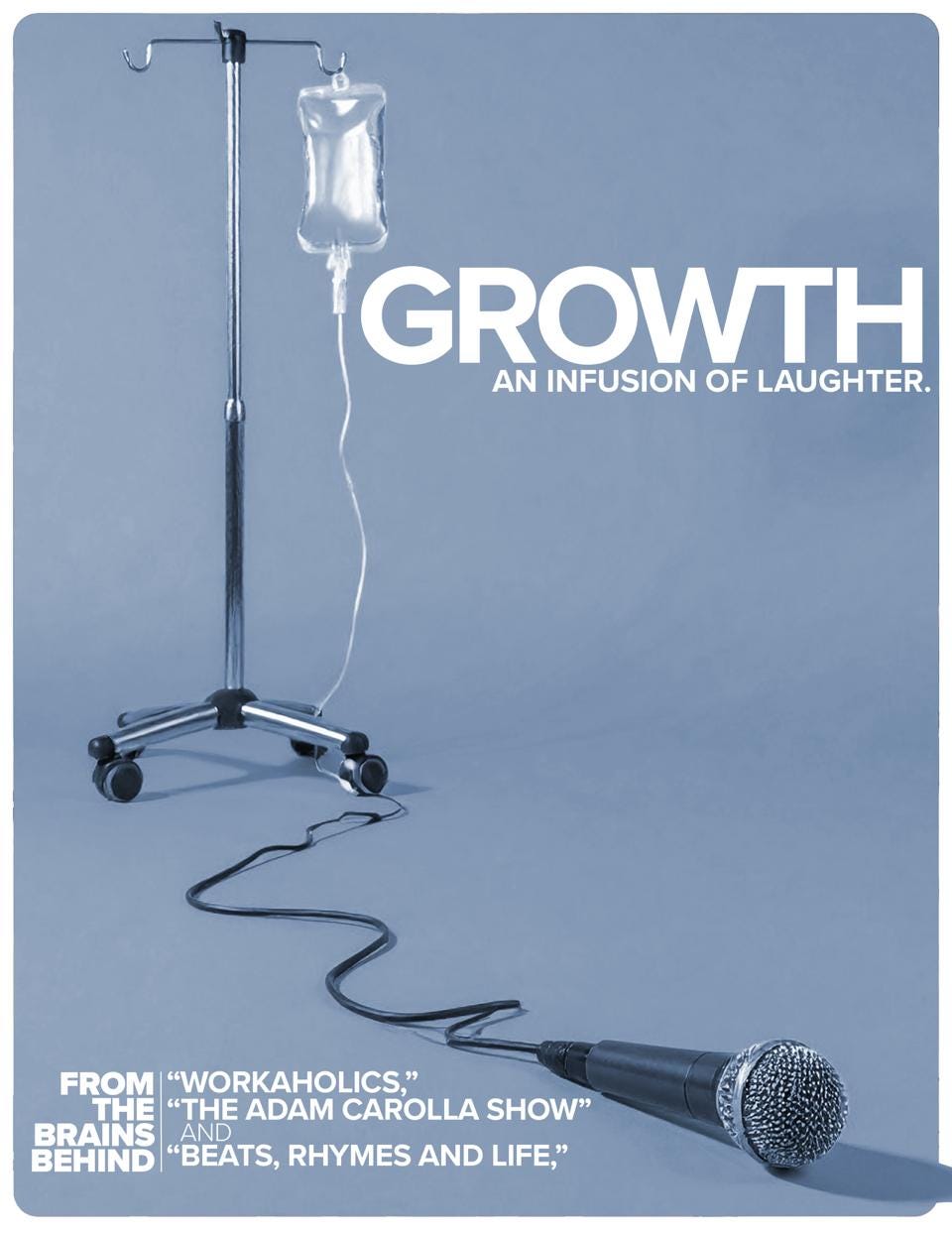
Growth (which will have its world premiere at Cinequest Film Festival in San Jose on March 15, 2026) is not the kind of cancer documentary audiences think they are signing up for. It is serious, yes. It is emotional. But it is also knowingly funny, occasionally absurd, and in one deliciously meta stroke, ends with a cheeky rug pull that feels like a quiet act of rebellion against the genre itself. Bishop is acutely aware of the conventions he is playing with. “We’ve got to inflate the balloon,” he says of the editing process. “Build up the tension, relieve the tension. It’s got to be that sort of dance.” That dance becomes the thesis of the film. Not laughing at cancer, but laughing in its presence.
At one point, Bishop says in the film, “Cancer is relentless and cancer will never quit, and that’s why we have to be relentless, and must never quit.” It sounds like something that could be stitched onto a pillow or printed on a charity T-shirt. But when you ask him what relentlessness actually looks like on a random Tuesday, his answer dismantles the cliché. “People are like, live every day like it’s your last. You know what? Do you have any idea how exhausting that would be?” he smiles. “You drained your bank account and punched your neighbor in the face because you didn’t like him? That would be terrible!”
For Bishop, relentlessness is about pacing, rest, community and knowing that “this fight is not this moment, and is not today. It’s a long fight.” It is not performative heroism. He quotes the late ESPN anchor Stuart Scott: “When you’re tired, rest.” That line, more than any soaring speech, feels like the quiet moral center of Growth.
Learning stand-up with a brain tumor
A decade after his diagnosis, Bishop decided to learn stand-up comedy and host a fundraiser for young adult cancer patients. It is one of those choices that sounds bold on paper and terrifying in practice. He admits it was both. “There’s nowhere to hide behind,” he says of stepping on stage alone. On radio, he could be the third voice, chiming in when he had something sharp to add. On stage, it was just him. “It’s just me now, and there’s no one to hide behind. Let’s make it work!”
Did the early material bomb? “Terrible. Really bad stuff,” he laughs.
What shocked him most was not the writing, but the performance. “It is not hardly at all about the joke writing. It is about the performing.” The rhythm, the pacing, the inflection. The act. And yet, embedded in the stand-up journey is something deeper. Bishop talks about what he calls a “spiritual debt.” After his initial diagnosis, friends and colleagues rallied, raising money and showing up in ways that overwhelmed him. The fundraiser was more about repayment than ego for him. “I felt a responsibility,” he explains. “So much money was raised for me, not just money, but goodwill, and effort, and time, and I wanted to give that back.”
The Secret Weapon: The Caretaker
If Growth has a secret weapon, it didn’t end up being a punchline. It is Bishop’s wife Christie. He does not hesitate. “My wife is the star of the show, both in my personal life and on the movie.”
Cancer stories tend to center the patient. The fighter. The warrior. Bishop is wary of that mythology. “We lionize this cancer warrior image,” he says, “when in fact, it’s hard, man. It’s hard to be a warrior.”
What the film does beautifully is widen the frame. The caretaker, he says, is often “shoved to the back, out of the spotlight.” Not for lack of importance, but because the attention understandably gravitates to the one who is sick. And yet, as Bishop makes clear, “that caretaker’s with them every step of the way. They are the unsung heroes.” In Christie, the film finds its emotional anchor. She is honest, steady and unvarnished in her reflections. You feel the weight she carried. You also feel the love.
It is impossible to watch her and not think of your own partner, your own family, your own child. That is where the gut-punching empathy creeps in. That is where the film quietly devastates.
Outliving the “expiration date”
Outliving a prognosis does not, Bishop insists, make him fearless.
“Not at all.”
He laughs at the idea that cancer automatically grants wisdom. One of his least favorite clichés is that it “puts things in perspective.” And yet, he admits, something does shift. “I do maybe freak out about less things,” he says.
Then he shares a story that feels quintessentially human. Early in his recovery, a mail carrier failed to take a letter he had left outside. He was furious. And then it hit him: “Isn’t it nice to be worked up about something other than dying of cancer?”
That line alone is worth the price of admission. There is gratitude in being annoyed. There is life in the trivial. Bishop also feels something else. Obligation. Not the suffocating kind, but a duty. He answers emails from strangers. He visits fans in hospital rooms. “Who am I to say no?” he shrugs. “What do I got going on? It’s Tuesday.” For some, surviving might mean compartmentalizing, or closing the chapter. For him, “that will always be part of my life.”
Can cancer be funny?
One of the most daring elements of Growth is its insistence that laughter is not disrespect. Rather, it is a form of resistance. Cancer survivor Julia Sweeney says in the film says you cannot make fun of someone with cancer. But if you have cancer, “by all means, have all the fun you want.” Bishop believes that perspective gives the audience permission. “This guy’s laughing at it, thus we’re invited to laugh with him.”
And he is right. The laughter in Growth is communal rather than cruel. As the film observes, it is absurd that your body can turn on you one day. Why not acknowledge that absurdity? Why not poke at it? The film does not trivialize suffering, but it refuses to let suffering have the final word.
Hope, without sentimentality
When I ask Bishop what he would say to people hesitant to watch something heavy, he smiles. “You’re probably right,” he jokes. But then he adds that audiences will likely “laugh more than you ever have at a cancer documentary.”
And he is correct.
The film is serious. It is silly. It has levity in unexpected places. It understands that life is absurd, and that cancer, in its cruelty, is also absurd. There is hope here, but not the syrupy kind. Bishop talks about advances in treatment over the past seventeen years. He talks about being at the bottom of a pit, grabbing onto small pebbles, one by one, pulling yourself up. You do not need a ladder. You just need something to hold.
That is what Growth offers. A handhold.
Bishop does not present himself as a saint. He is funny. Self-aware. Occasionally irreverent. Still deeply connected to the world of comedy that shaped his career. But beneath it all is something simple and profoundly moving. When he was told he had six months to live, he believed, against the odds, that it would work out. Seventeen years later, he is still here. Still making jokes. Still paying back what he calls a spiritual debt. Still pushing the boulder up the hill, one Tuesday at a time. And if cancer is relentless, he has chosen, quietly and stubbornly, to be relentless too.
I have been interviewing artists and filmmakers for more than two decades. You speak to enough extraordinary people and you develop a kind of professional distance. Admiration, yes. Curiosity, always. But every so often, someone slips past that guard and hits somewhere more personal. This was one of those conversations.
Cancer touches all of us eventually. A parent. A partner. A child. Ourselves. What Growth offers is not easy comfort. It offers permission. Permission to laugh in the middle of something terrifying. Permission to rest when you are tired. Permission to grab the smallest pebble and start climbing.
It is not a film about dying. It is a film about staying. And I hope as many people as possible seek it out.
Watch the full conversation below:
Listen to it wherever you get your podcasts, or listen right here:
If you enjoyed this interview, hit subscribe, leave a comment, and share your thoughts. I’d love to know what you think.
Stay tuned for more conversations and new episodes of the podcast, where we go deeper into the stories shaping film, television and the people who bring them to life.